


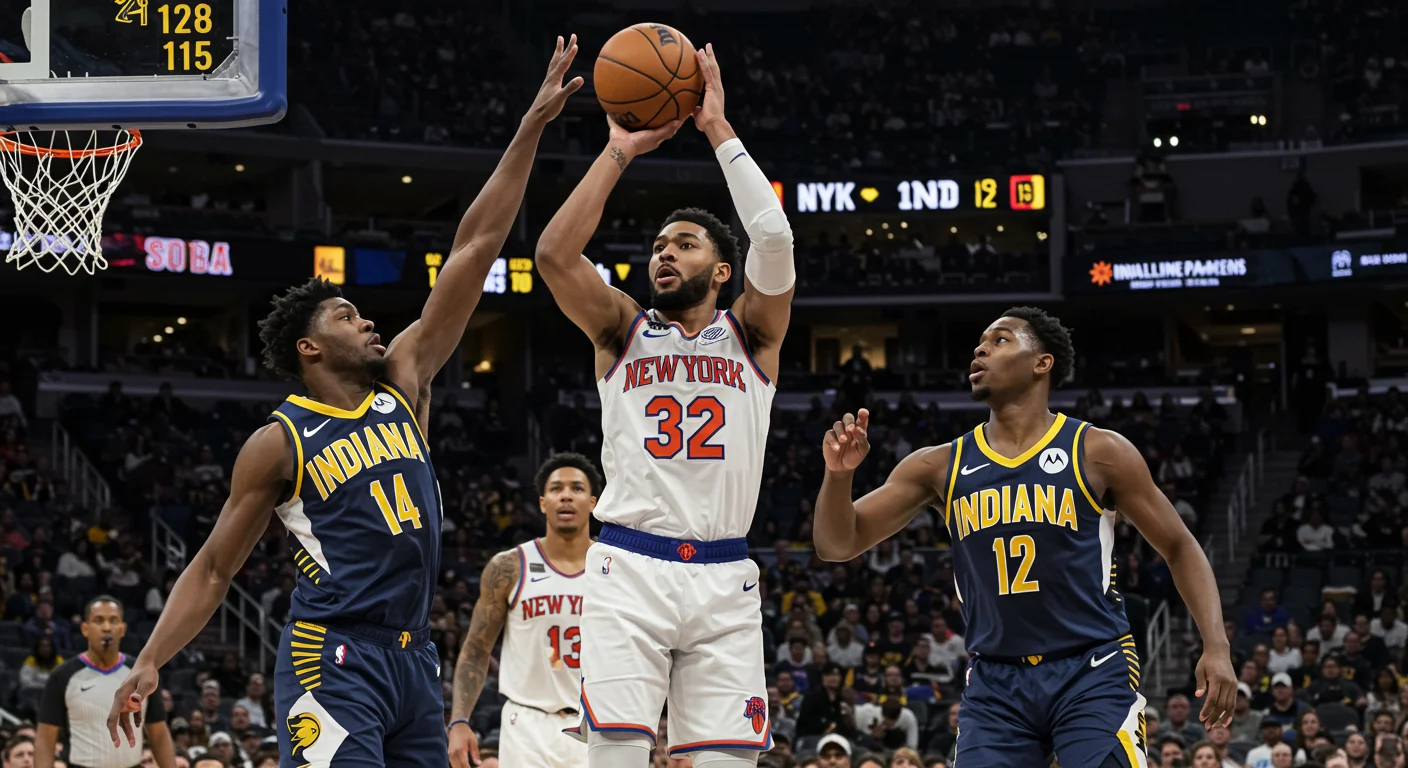
In the 2025 Eastern Conference Finals, the Pacers and Knicks renewed a classic rivalry. In Game 2, played on May 23, 2025 at Madison Square Garden (MSG), the Pacers came out with a 114–109 victory over the Knicks.
That win gave the Pacers a 2–0 series lead, underscoring their momentum and playoff poise early in the series.
In this article, we’ll break down:
The standout performances (who shone for each side)
Team statistical comparisons (shooting, rebounds, assists)
Tactical/qualitative analysis (what worked, what didn’t)
What this means going forward
Key Player Performances
Pacers: Rising to the Occasion
Pascal Siakam — Leading the Charge
Siakam exploded for 39 points on 15-of-23 field goals (including 3-of-5 from three) and 6-of-8 free throws. He added 4 rebounds and 3 assists.
His efficiency and aggressiveness were crucial in a tight, high-pressure playoff setting.
This marked a playoff career-high in points for Siakam.
Tyrese Haliburton — The Facilitator & Floor General
Haliburton posted 14 points, but more importantly choreographed the offense with 11 assists and grabbed 8 rebounds.
His ball-handling and playmaking helped the Pacers build and maintain momentum across quarters.
Core Supporting Cast: Balanced Effort
Myles Turner contributed 16 points (5-of-10 FG), with 3 rebounds. (Yahoo Sports)
Aaron Nesmith added 12 points, with a solid 4-of-7 shooting (2-of-3 from deep), and 7 rebounds. (Yahoo Sports)
Bench and role players added enough depth to keep the pressure on New York — showing the Pacers were not reliant on a single star. (Yahoo Sports)
Knicks: Fierce Resistance, But Not Enough
Jalen Brunson — Battling Hard
Brunson scored 36 points in the loss, showing resilience and offensive firepower. (Land of Basketball)
He also delivered 11 assists, matching Haliburton’s playmaking output on the other end — a sign of both teams relying heavily on their point guards.
Other Contributors & Team Effort
On the glass, Mitchell Robinson led the Knicks with 9 rebounds.
However, beyond Brunson and Robinson, the Knicks lacked a third force strong enough to match the balanced Pacers attack. The supporting cast didn’t consistently deliver high-scoring or efficient nights.
Team Statistics & Game Dynamics
Here’s a side-by-side statistical snapshot of the Game 2 performance.
| Category | Pacers | Knicks |
|---|---|---|
| Field Goal % | 51.8% (43-of-83) | 47.6% (40-of-84) (CBS Sports) |
| 3-Point % | 43.3% (13-of-30) | 34.4% (11-of-32) (CBS Sports) |
| Free Throws | 15-of-21 (71.4%) | 18-of-21 (85.7%) (CBS Sports) |
| Total Rebounds | 45 | 48 (CBS Sports) |
| Offensive Rebounds | 7 | 10 (CBS Sports) |
| Assists | 26 | 18 (CBS Sports) |
| Turnovers | 10 | 12 (CBS Sports) |
| Steals | 6 | 6 (CBS Sports) |
| Blocks | 3 | 4 (CBS Sports) |
What the Stats Reveal:
Efficiency and shooting: Pacers shot at a higher FG% and — a big difference — a much better 3-point percentage, which helped them build leads and respond when Knicks scored.
Ball movement & assists: The Pacers had 26 assists, significantly more than Knicks’ 18 — indicating cleaner ball movement and better execution.
Rebounding: Knicks had a slight edge in total rebounds (48 vs 45) and had more offensive boards, but Pacers managed to limit second-chance scoring sufficiently.
Free throws & clutch execution: Knicks had a high free throw efficiency (85.7%), but that alone couldn’t offset Pacers’ better shooting mix and teamwork.
Turnover control: Pacers turned over the ball slightly less, helping them maintain possession and limit easy Knicks opportunities.
Tactical and Qualitative Analysis
Pacers’ Game Plan: Balanced Depth + Star Execution
The Pacers leveraged a two-pronged attack: a high-efficiency star in Siakam plus a playmaking hub in Haliburton. This dual threat forced the Knicks to pick their poison — double Siakam and give Haliburton open looks, or vice versa.
Their balanced scoring — with contributions from bench and supporting starters — prevented the Knicks from focusing on shutting down one or two players.
Smart shot selection: A mixture of inside plays (Siakam, Turner), 3-point threats (Pacers hit 13 triples), and free-throw conversions. This diversity kept the Knicks defense guessing.
Good ball movement and assist distribution — 26 assists show that scoring was not isolated but spread out, reducing predictability.
Knicks’ Shortcomings: Reliant on Brunson, Lack of Consistent Support
While Brunson delivered 36 points and 11 assists, the supporting cast didn’t provide enough scoring punch. Outside of him and Robinson (on boards), few Knicks players had standout stat lines.
Lower 3-point percentage and fewer team assists indicate less ball movement and possibly more isolation plays — which worked against them when Pacers played disciplined defense.
Possession value: Slightly higher turnovers, and inability to convert enough offensive rebounds or second-chance points to offset Pacers’ balanced scoring.
The Pacers’ defensive discipline — contesting shots, limiting easy looks — may have disrupted Knicks’ offensive rhythm, particularly limiting open heterogenous scoring sources.
What This Means for the Series & Broader Implications
The Pacers’ win in Game 2 shows that they are not a one-man team: they have depth, balance, efficiency, and stars — a potent combination in playoffs where consistency matters.
For the Knicks, this game should be a red flag: relying too heavily on one star (Brunson) is risky; they need multiple reliable scoring options and better ball movement to compete.
Going forward, if Pacers maintain this kind of balanced contribution, they can force the Knicks into uncomfortable defensive rotations and mismatches.
For Knicks: need adjustments — perhaps getting better production from forwards/role players, improving 3-point shooting consistency or better exploiting mismatches — to even the series.
Conclusion
The Game 2 showdown between Pacers vs Knicks Match Player Stats revealed a lot about both teams. The Pacers demonstrated that when a team blends star performance (like that of Siakam), disciplined playmaking (Haliburton), and balanced team contributions — they become hard to beat. Their superior shooting efficiency, assist rate, and smart execution gave them the edge.
On the other hand, the Knicks — despite a heroic effort from Brunson — showed vulnerability in their overreliance on a single star and lack of consistent support from the rest of the roster. The shortcomings in three-point shooting, ball movement, and depth prevented them from capitalizing on rebounds or free-throw efficiency.
In short: Pacers’ team-oriented basketball shone brighter than Knicks’ individual heroics — a lesson that often determines playoff success.
(FAQs)
Who was the Pacers’ top scorer in Game 2?
Pascal Siakam, with 39 points.
How did Tyrese Haliburton contribute beyond scoring?
Haliburton recorded 11 assists and 8 rebounds, making him crucial in playmaking and ball distribution.
Did the Knicks have any double-digit rebounders?
Yes — Mitchell Robinson led New York with 9 rebounds.
Which team had better shooting efficiency?
The Pacers shot better overall — 51.8% FG and 43.3% 3-PT, compared to Knicks’ 47.6% FG and 34.4% 3-PT.
What was the difference-maker in this game?
Balanced scoring, efficient shooting (especially 3-PT), and superior ball movement by the Pacers — combined with the Knicks’ lack of consistent secondary scoring.
